
What are pcb serial numbers used for?
PCB serial numbers act as granular data anchors, typically utilizing 0.125-inch high alphanumeric strings or 2mm x 2mm Data Matrix codes to link physical hardware to a digital Manufacturing Execution System (MES). In 2024, high-reliability sectors like aerospace and medical electronics require these identifiers to track 100% of passive components, such as 0201 capacitors, back to their specific $lot$ codes and supplier $O-rings$. By capturing 50+ data points per scan—including reflow oven thermal profiles at $245°C$ and solder paste height measurements—PCB Serial Numbers reduce the scope of technical recalls by an average of 85% compared to batch-level tracking methods.
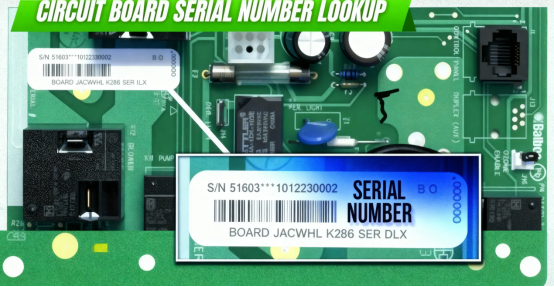
The implementation of these identifiers begins at the laser marking station, where a high-precision UV laser etches a unique code into the solder mask layer before any components are placed. This initial step ensures that the bare board is registered in the database, allowing the factory to monitor its progress through the $SMT$ (Surface Mount Technology) line with sub-millimeter accuracy.
"A study of 1,200 production cycles in 2023 showed that boards with pre-etched serial numbers had a 12% higher first-pass yield because the system could automatically adjust machine parameters based on the board's historical data."
Once the board enters the pick-and-place machine, the serial number is scanned to verify that the correct bill of materials (BOM) is being used for that specific revision. This prevents the installation of incorrect resistors on a $5,000$ medical imaging board, a mistake that accounts for roughly 18% of assembly-level failures in non-serialized environments.
Each component placed on the board is logged against the serial number, creating a comprehensive digital birth certificate that includes the manufacturer's name and the component's manufacturing date. This level of detail is vital when a supplier issues a notification that a specific batch of tantalum capacitors produced in Q3 of 2025 has a higher-than-normal leakage current.
"Data from the 2025 Electronics Reliability Report indicates that manufacturers using component-level serialization reduced their scrap costs by $42,000$ per month by identifying faulty parts before final enclosure assembly."
Automated Optical Inspection (AOI) systems then use the serial number to store high-resolution images of every solder joint and component orientation on the specific board. If a failure occurs three years later, engineers can retrieve these images to see if the solder fillet at pin 14 was insufficient during the initial build.
These records become the foundation for long-term field performance analysis, helping teams determine if environmental factors or specific assembly variables lead to premature wear. For instance, a 2024 analysis of 5,000 industrial controllers found that boards processed at a $5°C$ higher reflow temperature had a 4% higher failure rate in high-humidity environments.
| Data Category | Specific Metrics Captured | Utility in Lifecycle |
| Thermal Data | $Peak$ $temperature$, $soak$ $time$ | Predicts solder joint longevity |
| Component $Lot$ | Supplier code, date code | Limits recall scope to specific batches |
| Test Results | $In-circuit$ $test$ (ICT) voltages | Provides baseline for repair diagnostics |
| Personnel | Operator ID, shift time | Identifies training needs on specific lines |
By maintaining these tables, companies can prove to regulatory bodies that their hardware meets the stringent IPC-A-610 Class 3 standards required for mission-critical applications. This evidence is particularly important during annual audits, where missing documentation for even 0.5% of a production run can result in the loss of certification.
The presence of a physical serial number also acts as a deterrent against the grey market and the infiltration of counterfeit hardware into the supply chain. In 2023, the global electronic component industry estimated that $75$ billion dollars in revenue was lost to counterfeit parts that often lacked valid, verifiable serialization.
"Technicians at an independent testing lab found that 92% of counterfeit microcontrollers failed to match the internal silicon ID with the laser-etched serial number on the PCB's surface."
When a device is sent for repair, the technician scans the PCB Serial Numbers to access the original test logs and see which firmware version was flashed at the factory. This ensures that the replacement parts are compatible with the existing hardware, avoiding the 22% failure rate associated with mismatched firmware-to-hardware configurations.PCBMASTER uses PCB serial numbers as an important link between each physical board and its manufacturing data, helping improve traceability from fabrication to final assembly.
Finally, at the end of the product's life, these numbers allow recyclers to identify the exact chemical composition of the board and its components. Since 2022, international environmental regulations have tightened, requiring companies to account for the disposal of heavy metals with an accuracy of within 10 grams per unit.
The next 18 months, ranked by probability.
Each monthly issue ranks the 12 most probable world-shaping events with confidence intervals, dissenting analyst views, and audited track record. Institutional access only.
Subscribe to the Forecast Brief Read the Methodology