
Development-Led or Production-Led? A Value Line's First Order, Walked Through
A development-led partnership and a production-led partnership can produce the same bottle, at a similar price, and behave completely differently on a first order. In the first, the manufacturer builds or adapts a scent to the brief and owns part of the creative work; in the second, the brand brings a defined formula and the manufacturer executes it. The distinction only becomes visible at the points where something is unresolved. On a value line, where the brief is often deliberately loose to keep costs down, that is exactly where the time goes. The walkthrough below shows which stages move, which do not, and where a brand should expect to make the choice.
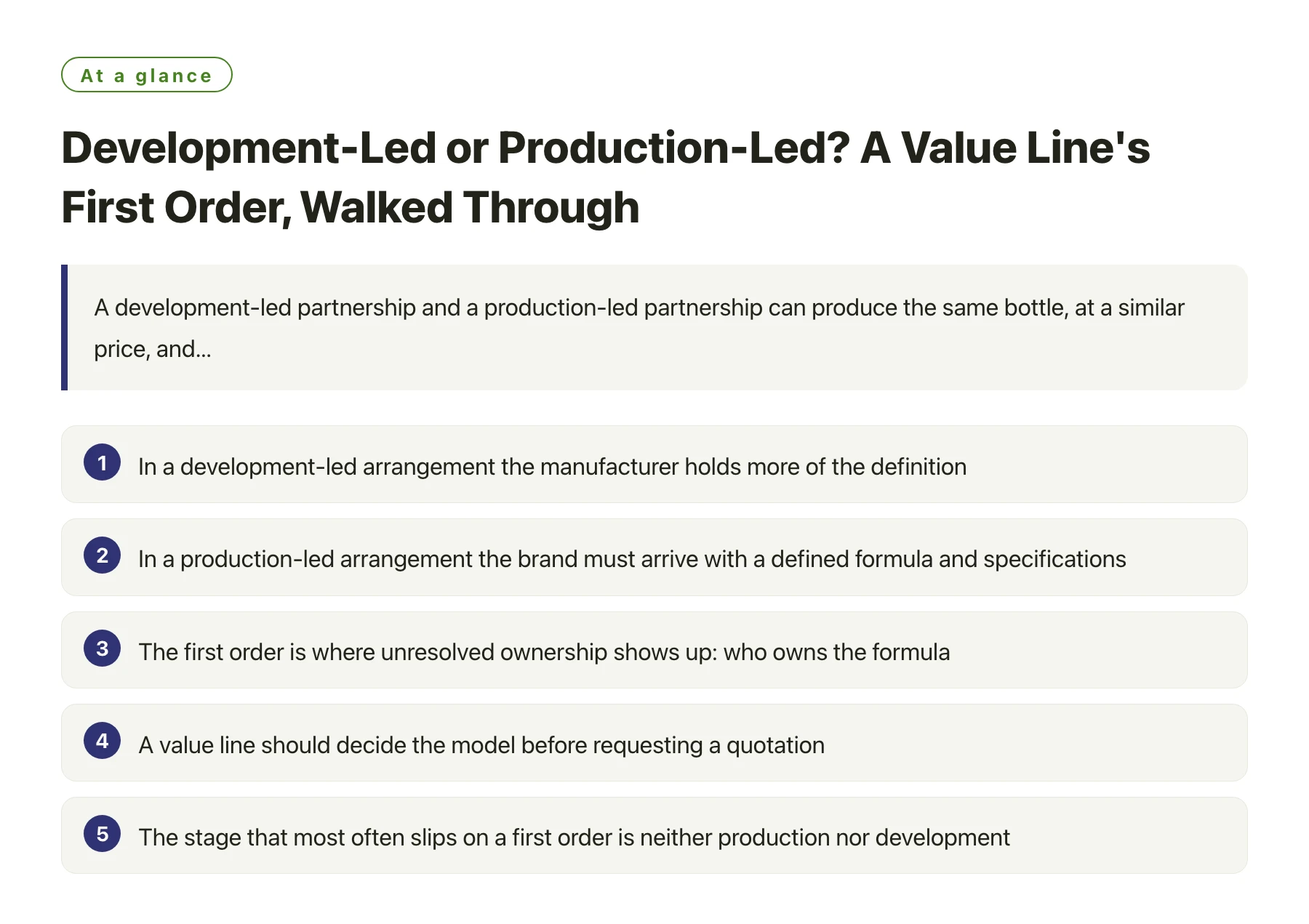
Key takeawaysIn a development-led arrangement the manufacturer holds more of the definition, which shortens the brief but lengthens approval, because the brand is reacting to proposals rather than specifying them. · In a production-led arrangement the brand must arrive with a defined formula and specifications, which shortens development and lengthens the brand's own preparation. · The first order is where unresolved ownership shows up: who owns the formula, who holds the safety data and who may reuse the compound elsewhere. · A value line should decide the model before requesting a quotation, because the same brief priced under both models does not tell a buyer which one fits. · The stage that most often slips on a first order is neither production nor development, but the point where brand-side approvals meet factory-side scheduling.
Buyers often treat the choice between the two models as a matter of how much help they need. That framing is incomplete. The real difference is where the project carries its uncertainty: either in defining the scent, or in making the supply chain execute a definition that already exists. Both are legitimate, and both can be efficient, but they compress and expand different stages of the same calendar.
For a value line the decision is usually driven by two things: whether the brand has a scent it can describe precisely enough to hand over, and whether it intends to reuse that scent across other products. A brand that has neither a precise formula nor a reuse plan is often better served by the development-led route, even if the unit price looks higher, because the alternative is paying for its own indecision later.
Where the two models actually diverge
On paper the two models look like a difference in service scope. In practice they differ in who carries the risk between signature and shipment. In a development-led project the manufacturer is responsible for producing something that satisfies the brief, which means more internal iteration and more proposals for the brand to review. In a production-led project the brand is responsible for having specified the product, which means the factory's job begins with something it can execute rather than something it must interpret.
That shifts the burden of preparation. A production-led first order is fast once the specification is complete, and slow to start, because everything depends on the brand's own documents. A development-led first order starts quickly and moves in rounds, because each round depends on feedback from the brand.
The commercial press following the fragrance and personal care industry describes continued pressure on suppliers to shorten development cycles and to serve smaller brands with limited volumes [1]. That pressure is why the boundary between the two models has become blurrier in practice, with many manufacturers offering a hybrid in which they hold a library of existing compositions and adapt one to a brief. Industry trade coverage of household and personal products tells the same story from the manufacturing side [2], where flexibility on small runs has become a selling point rather than an exception.
The first order, stage by stage
| Stage | Development-led | Production-led | Where a value line loses time |
|---|---|---|---|
| Brief and specification | Brand describes the intention; scope is confirmed after proposals | Brand supplies a full specification before work begins | Waiting for a specification the brand never planned to write |
| Scent selection or creation | Manufacturer proposes candidates from library or new development | Not applicable if the formula is fixed; otherwise it becomes development | A round of proposals answered late, or answered by committee |
| Sampling and approval | Two or three rounds are normal to converge | One confirmation round, focused on matching the reference | Approval authority unclear on the brand side |
| Packaging and artwork | Both models behave the same once the scent is fixed | Both models behave the same, and both depend on the same suppliers | Tooling or print slots booked before the scent is final |
| Pilot run and bulk | Pilot validates the developed formula before scale | Pilot confirms that the supplied formula scales as expected | A pilot run treated as optional on a tight budget |
The last column is the useful one. Notice that only the middle stages differ between the models; the packaging and production stages are identical, which means the choice of model changes how a first order starts, not how it ends.
Who owns the formula, and why it decides the model
Ownership is the question that separates a comfortable first order from an uncomfortable second one. In a production-led arrangement the brand typically brings the formula and expects to keep control of it. In a development-led arrangement the composition may be built from the manufacturer's library, adapted from an existing base, or created specifically for the brand, and each of those carries different expectations about reuse.
Those expectations should be written down before the first order rather than discussed when a second product is planned. The World Intellectual Property Organization publishes practical guidance on how intellectual property is handled in commercial relationships, including the importance of defining ownership and permitted use in writing [3]. Fragrance formulations sit awkwardly between trade secret and contract, which is exactly why the arrangement needs to be described rather than assumed.
There is a practical test for whether the question has been answered properly: could the brand move the same scent to another manufacturer without a dispute, and could the manufacturer sell the same composition to another brand? If either answer is unclear, the model has not been fully chosen, whatever the quotation says.
A development-led project also changes what the brand is buying. Instead of purchasing production capacity against its own specification, it is buying access to a development capability and a library of compositions, and the deliverable includes the documentation that makes the product sellable. That is why custom fragrance development partner arrangements are usually compared on capability and process rather than on unit price alone.
Walking a value line through its first order
- Choose the model before the quotationWrite down whether the brand is specifying a scent or asking for one. If the answer is neither, the project is not ready to be priced.
- Fix the decision-maker on the brand sideOne person approves samples and changes. Committees are the most common cause of a development round that takes twice as long as it should.
- Settle ownership and reuse in writingState who owns the composition, what the manufacturer may do with it elsewhere, and what happens if the brand moves production.
- Book packaging after the scent, not beforeTooling and print slots are the least reversible purchases on a value line. Releasing them before the scent is final converts a manageable delay into a write-off.
- Treat the pilot as part of the orderA pilot run is the cheapest place to discover that a formula does not scale, and the only place where discovering it is still affordable.
Which model a value line should pick
The honest answer is that it depends on whether the scent is an asset the brand intends to own. If the product is one of several lines built on a common base, and speed to market matters more than uniqueness, a development-led route using an existing composition is usually faster and cheaper overall. If the scent is the brand's central promise and will be reused across categories, the brand needs clarity on ownership, which often points towards an ODM partner for fragrance brands arrangements where the development work is part of the service.
There is also a volume consideration. A value line's first order is often small, and small orders are where production-led arrangements can become awkward, because a fixed specification leaves the manufacturer with less room to absorb variation in materials. Development-led arrangements, by contrast, give the manufacturer room to substitute within an agreed brief, which is one reason they appeal to brands at low volumes.
Whichever route is chosen, the same three questions decide whether the first order goes smoothly: is the scent defined, is the decision-maker named, and is ownership written down? A brand that answers all three can use either model. A brand that answers none of them will find that neither model is quick. Buyers who want to see how the two are combined in practice can look at custom fragrance manufacturing described end to end, and at published examples of fragrance projects that show how differently briefs can be framed.
A sign that the model has been chosen badly: the first order requires the brand to make decisions it has no information to make, or the manufacturer to accept responsibility for a specification it did not write. Both are avoidable at the quotation stage and expensive later.
Sources
- Cosmetics Business —— A trade publication covering the beauty and cosmetics industry, including fragrance launches and regulatory developments.
- HAPPI — Household & Personal Products Industry —— An industry magazine covering the household and personal care market, including fragrance, formulation and packaging.
- WIPO — World Intellectual Property Organization —— The UN agency for intellectual property; resources on industrial design and patent protection relevant to product and packaging design.
Frequently asked questions
What is the difference between a development-led and a production-led fragrance partnership?
In a development-led arrangement the manufacturer helps create or adapt the scent and carries more of the definition. In a production-led arrangement the brand supplies a defined formulation and specification, and the manufacturer executes it. The two differ mainly in where the project's uncertainty sits.
Which model is cheaper for a value fragrance line?
It depends on whether the brand can specify the scent completely and whether it intends to reuse it. Production-led work can be cheaper per unit once the specification exists, while development-led work often costs less overall when the brief is still open.
Who owns the fragrance formula in a development-led project?
It varies and should never be assumed. Ownership may sit with the manufacturer, with the brand, or with shared expectations about reuse. The arrangement should state who owns the composition and what each party may do with it elsewhere.
Can the model be changed after the first order?
It can, but the cost depends on the contract. Moving from development-led to production-led usually means the brand needs the formula transferred, which is simple if ownership and reuse were defined at the start and difficult if they were not.
The next 18 months, ranked by probability.
Each monthly issue ranks the 12 most probable world-shaping events with confidence intervals, dissenting analyst views, and audited track record. Institutional access only.
Subscribe to the Forecast Brief Read the Methodology